Translate

Showing posts with label sabarimala. Show all posts

Malikappurathamma

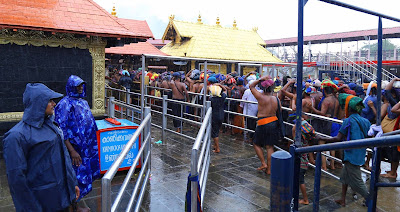
The Maalikappuram Temple, located at the right side of Sabarimala main temple is dedicated to Malikappurathamma, the Devi who was dedicated to Ayyappa and wished to marry him. One of the stories about Malikappurathamma is related with the Kalari School, Cheerappanchira .The Pandalam Raja admitted Ayyappa in this school to study Martial arts (Kalari) from the Guru, Kalari Panicker. Leela, his daughter fell in love with the Prince. But being a Brahmachari, Ayyappa couldn’t accept her passion. But he gave her a word that, he will marry her certainly, if there is no Kanni Ayyappas at Sabarimala.


Another story related to Malikappurathamma goes like this: After Mahishi was killed, a beautiful lady appeared from the body of Mahishi. She requested Ayyappa to marry her and accept her as his soul mate. But due to his mission and the state as a Yogi, Ayyappa refused it. But due to the incessant beseech of the girl, the Lord gave her the word that he will definitely marry her at that time when there will be no Kanni Ayyappas in his abode at Sabarimala.

It is said that the Malikappurathamma is Madhura Meenakshi, the Kula Paradevatha of Pandalam Royal Family which has conections with Pandya Dynasty.

The main rituals at Maalikappuram temple are Pattudayada, Pottu, Chandu, Kanmashi, Vala and Bhagavati Seva. Rolling of coconuts (thengai urutt) is another major ritual which is performed in this temple. The sub deities in this temple are Nagaraja, Navagrahas, and KochuKadathuSwami. Malikappurathamma is taken from MalikapuramTemple to Saramkuthi in a pageant every year. This procession is adorned with traditional music including pandy melam. The same procession will return to Malikappuram in a silent manner which symbolizes the grief of Devi who sees thousands of arrows at Saramkuthy. This is a symbolic ritual to know whether any Kanni Ayyappas have visited to Sabarimala. After seeing thousands of arrows at Saramkuthi, the Devi sadly returns to her shrine and will wait till next season commence. The Manimandapam, where Ayyappa meditated to become the Moorthy is also situated here.


There was only a Peeda Prathishta (holy seat) at Malikappuram till the fire disaster in Sabarimala. The idol of Malikappurathamma was installed by Brahmasree Kandararu Maheswararu Thanthri. The Devi at Malikappuram holds a Sankh, Chakram and Varada Abhya Mudras. Now the idol is covered with a gold Golaka. The temple also was reconstructed in the last decade and now the conical roof and sopanam is covered with gold.


S. Rameshan Nair, the veteran lyric writer and poet in Malayalam, describes about Malikappurathamma in a devotional musical album Ayyan like this

Maalikappurame maamalathaye madhura viraham maanjuvo
Nenchile theeyum Ambika neeyum nerairaathe thengiyo

Malayil aalozhiyunnu manjalil varika ne vadhu eanna pol
Aaayiram sharamunakal ealkkumoraalmaram thalarunnu pol

Dharmapalakan Ayyane pala janmamayi ninachu nee
Karmasakhsiye saakshi aakki orammayakan nootu nee

Mohamokke udanja mankudamayatengane Ambike
Poy varum vazhi neele mullukal aanuninte padanthike

Kaalanijoru noopuram puzhayaayatho vana geethike
Kanduninnna Maharshimar Maramayatho Shruthisharikee

Nin mukhathinu manjalayathu mannil veenu kalarnnu poy
Karal niranja vishadamayathurundu naalikeramaay

Kaatilo neduveerppilo kanaletta karppurambike
Ninte viraha sugandhamaalukal nenjiletti maranjupoy

Nooru vedanathigiyaloru mookamaadhuri aayidaam
Devathe oru sanmuhoortham nale nale ananjidam

Oh! The divine mother of the mighty mountains, Malikappurathamma, has the sweet parting state of you have now changed …? You along with the fire in heart wept at this time without knowing the fact….? See the last one who came to see Lord has gone from the mountain and the place is vacant. You can now come in the attires of bride. But look at the great banyan tree there. It has become exhausted bearing thousands of arrows….! For many janmas you have been thinking of Lord: the protector of Dharma. You made vratas to become the mother of mountains. But how your desires were broken as a mud pot? Your path is now full of thorns also. Is that your ornaments that worn in foot that became the river? Seeing all these, the Rishis stood immovable like gigantic trees!!!The soil here gets mixed with the turmeric that oozed from your face. The sorrow in your heart gets transformed into coconut that rolled here. In the breeze and on your breaths, a hot fire ball gets impacted .The devotees perceived your story of parting as a sweet smell and gone from the hills. Is it true that a hundreds of pain will aggregate into a silent lovable voice! O,Devi a good moment will certainly approach tomorrow as YOU hopes ……….!

The Devi still has faith in Lord that one day he will receive her as his soul mate. Ayyappa never told her that he won’t accept her love and devotion for him. He said the day when there will be no Kanni Ayyappas in the hills, he will receive Devi. This is an unique example of faith and word. Devi is not at all disappointed. She is the mother of the hills, who protect each and every devotee, whether he is the first man or Guruswamy (the man who had visited Sabari mala for 18 times (Mandalam).Every time Devi comes to the Saramkuthi to clarify the fact .But she will return seeing the arrows, which is the unique symbol of Kanni Ayyappas ( the first time visitors).

Maalikappuram Devi: Dimensions of the eternal Motherhood 

The word mother denotes the universal consciousness (sanctity) (Prapanja Chaitanaym). The God and the divine universe (Prakirti) together forms the true vision of this entire universe Those who visit Maalikappuram temple , can see a Thirshoolam at the temple. The three segments of Thirshoolam symbolize Ichashakthi ( the Strength for desire) ,Njanashakhti(Strength of Knowledge) and Karmashakthi(Strength of duty).Ichashakthi is that sort of power that make one to think to go well. It includes the desire for good; victory etc.The second is Njaanashakti, which is none other than the power of knowledge. Knowledge itself is power as it forms the base of all activities. So one should get the power of knowledge within him.Becasue the knowledge aspect is quite essential to do any form of duties. The third segment is Karmashakthi, which is the power to do the duties (Pravrithipadam). The Thirshoolam at Maalikappuram temple represent the above mentioned three specifications.

Everyone who comes to Maalikappuram temple must try to understand the science behind this Thirshoolam than merely paying a bow to it. The person who conceives these facts can go ahead without facing any barriers .We also can see a lighted lamp in the temple. It’s the light of knowledge that is meant to enlighten our life. Malikappurathamma is giving this ultimate knowledge to us. Ayyappa had given the place of Mother to Devi. That’s why she is called Malikappurathamma . It means she is the mother who teaches the meaning of the pilgrimage to her children , who comes there as devotees to see the Lord Ayyppa.And After conceiving this knowledge form mother , when they bow to the lord at holy sanctum , they will be aware of the ultimate fact that “ It’s You” (Tatwamasi). Malikappurathamma through her ultimate faith and devotion to Swamy teachers every devotee that the faith and hope are the true determinants of extreme Bhakti.The God certainly not is the ‘the boon giver’ on demand, which is now a pseudo synonym for the Praying. The God doesn’t give whatever the person demands, request or even plead without true faith in the supreme power. A devotee who is going to Sabarimala shouldn’t envisage the power of demand even if he has successfully completed each and every tedious vratas and rituals. But he definitely should have the power of trust, truth and hope. Some person thinks that as he has undergone all the rituals which are the prerequisites for Sabarimala pilgrimage, he is now well set to ask what he wants and the Lord will certainly do the rest .But without faith and hope, all the rituals are of no value. The value of Bhakthi is reflected in owns own faith and hope. Malikappurathamma teaches this lesson to every devotee who wishes to go to see Lord Ayyappa. Even after a long attempts, neither she become diffident of the act nor she lost the confidence and hope in her desire. Devi hopes that a day will come surely on which Lord Ayyappa will accept her as his wife.

Devi adorns a very important place as the mother goddess of the mighty Sabari Hills, in which Lord Ayyappa dwells with his extreme power. Malikappurathamma herself shows truthful and powerful devotion to Ayyappa. She in turn acts as a catalyst, who cannot be ignored at any moment of Mountain journey. She is the idol of complete passion, devotion, faith, hope and of course the power of patience at the ultimate point. Malikappurathamma is also called Manchambika and Mancha mathavu. Mancham means seat or throne and it is the Panchabramasana of Lalitha Devi. From this aspect it is revealed that Malikappurathamma is a form of Lalitha Thripurasundari.

Aham Brahmasmi and Tattvamasi

The important message written at the temple facade is one of the four Mahāvākyas of Advaita or the non-dualistic school of philosophy. 

Tat Tvam Asi, the 3rd of four Mahavakyas which in sanskrit translates to "Thou Art That" is the principle philosophy that governs the temple and pilgrimage. 

As the pilgrimage is symbolic for the journey to self realization that all living beings possess the essence of Brahman, pilgrims refer to each other as Swami, acknowledging their divinity.

It means, in short, you are part of the Paramatma which is the quintessence of Advaita philosophy.

Sabarimala Pilgrimage


The devotees are expected to follow a Vratham (41-day austerity period) prior to the pilgrimage.[4] This begins with wearing of a special Mala (a chain made of Rudraksha or Tulasi beads is commonly used, though still other types of chains are available.). During the 41 days of Vratham, the devotee who has taken the vow, is required to strictly follow the rules that include follow only a lacto-vegetarianism diet, follow celibacy, follow teetotalism, not use any profanity and have to control the anger, allow the hair and nails to grow without cutting. They must try their maximum to help others, and see everything around them as lord Ayyappa. They are expected to bath twice in a day and visit the local temples regularly and only wear plain black or blue colored traditional clothing. Saffron colored dresses are worn by Sannyasi who have renunciated material life. But, many devotees still continue to wear saffron colored clothes which becomes a part of Vedic culture which connects the whole Hindus worldwide.

Hundreds of devotees still follow the traditional mountainous forest path (approximately 61 km) from Erumely,12.8 km from Vandiperiyar and 8 km from Chalakayam, believed to be taken by Ayyappa himself. The Erumely route starts from Erumely to Aludha river, then crosses the Aludha mountain to reach Karivilam thodu. Now comes the sacred Karimala crossing, from there to Cheriyanavattom, Valliyanavattom and finally Pamba River. Then they have to climb Neelimala and enter into the Ganesha-Bettam, Shreerama-Betta Padam. Then comes the Aranmula kottaram, which is one of the stops of holy journey 'Thiruvabharana Ghoshayatra' (the grand procession of the divine jewelery).

These days people use vehicles to reach the Pamba River by an alternate route. From Pamba, all the pilgrims begin trekking the steep mountain path of Neeli Mala till Sabari Mala. This route is now highly developed, with emergency shops and medical aid by the sides, and supporting aid is provided to the pilgrims while climbing the steep slope, which used to be a mere trail through dense jungle. The elderly pilgrims are lifted by men on bamboo chairs till the top, on being paid.

Thanka Anki


The ‘Thanka Anki’ is the sacred gold attire worn by Sree Ayyappa during the Mandala Pooja. The late Chitra Tirunal Balarama Varma of Travancore dynasty offered the ‘Anki’ weighing 420 sovereigns, to Sabarimala Ayyappan in 1973.

The ‘Thanka Anki’ is stored at the Aranmula Parthasarathy Temple – one of the prominent temples dedicated to Krishna in Kerala. 


Ahead of Mandala Pooja, the ‘Thanka Anki’ is taken for Aranmula to Sabarimala with a ceremonial procession, a practice that introduced by the Travancore Devasom Board.

The motorised chariot bearing the sanctified ‘Thanka Anki’ is given a rousing reception with pilgrims gathering in huge numbers at the various points of its transit in Omalloor, Konni and Perunadu.


Sabarimala Temple Openings 2018-2019


Lord Ayyappan - Birth & History

The members of Pandya dynasty ousted by Thirumala Naicker the ruler of the erstwhile 


Pandya Empire spanning Madurai, Thirunelveli and Ramanathapuram lived in places like Valliyur, Tenkasi, Shengottah, Achankovil and Sivagiri. They had also established their supremacy in parts of Travancore, and some of them belonging to Chempazhanattu Kovil in Sivagiri were given the right to rule the country of Pandalam by the King of Travancore, some eight hundred years ago. King Rajashekara, the foster-father of Lord Ayyappan belonged to this dynasty.

A just and precocious sovereign King Rajashekara was held by his subjects in high esteem. Under him, the region was witnessing a goldenage. But the king had one sorrow – he was childless and thus had no heir to inherit his throne. Both the hapless king and his queen prayed ceaselessly to Lord Shiva for a child.

Around the same time, a demon by the name of Mahishasura undertook severe penance (tapas) and consequently Lord Brahma was forced to grant his wish that nobody on earth could annihilate him. Emboldened by Brahma’s boon, Mahishasura commenced systematic destruction of people and pulverized tribes and communities. Terrorised and fearing his wrath, people fled to distant lands. Realizing that only a superhuman power could exterminate the wayward Mahishasura, the devas appealed to Goddess Durga, who killed him in a bloodybattle.

Determined to avenge her slain brother, Mahishi, the sister of Mahishasura secured a boon from Lord Brahma that no being except the offspring of Vishnu (Hari) & Shiva (Haran) could slay her. In due course of time, Mahishi went to Devaloka and began harassing the Devas who in turn implored Lord Vishnu to intervene. As the boon was that nobody except the son of Lord Shiva & Vishnu could kill Mahishi, Lord Vishnu assumed the female persona of Mohini who helped devas prize Amrit away from asuras; it was decided that the male child born out of the union of Mohini and Lord Shiva would be placed under the care of Lord Shiva’s childless devotee, King Rajashekhara of Pandalam.

On one of his hunting trips to the forests near River Pampa, as King Rajashekara reclined on the banks of river mulling over the natural beauty of the surroundings and waterfalls, he heard an infant’s wails from the forest. Astounded, he followed the sounds and came upon a beautiful child furiously kicking its feet and arms. The king stood there, perplexed – he longed to take the child home to his palace.

Whilst King Rajashekhara beheld the divine child, a sadhu appeared from nowhere and instructed him to take the infant to his palace. Also the mendicant assured him that the child would mitigate his dynasty’s sufferings and that when the boy turned twelve, Rajashekhara would be aware of his divinity. As the child was wearing a gold chain, the sadhu directed the King to name him ‘Manikandan’ – one with a golden neck.

Ecstatic, Rajashekhara took Manikandan home and narrated the happenings to his queen. They both felt that they had been blessed by LordShiva himself. All except the Diwan who had entertained hopes of becoming king after Rajashekhara, rejoiced in the royal couple’s happiness.

As a child, Manikandan was very intelligent and precocious. He excelled in martial arts and shastras and surprised his guru with his brilliance and superhuman talents. Peace and prosperity reigned in Pandalam. Eventually, Ayyappan’s guru concluded that the boy was no ordinary mortal but a divine being. Upon completing his studies, Manikandan went up to his teacher to offer guru dakshina and seek his blessings in turn.

As he approached his spiritual master for ashirwaadams, the guru explained to Manikandan what he had already surmised about him, that he was a divine power destined for superhuman glory. The guru then beseeched him to bestow vision and speech upon his son who was blind and dumb. Manikandan placed his hands on the guru’s son and the boy immediately gained eyesight and speech. Requesting that this miracle be revealed to none, Manikandan returned to the royal quarters.

Meanwhile the Queen had given birth to a male child who was named Raja Rajan. Sensing these miraculous turn of events were somehow inextricably linked to Manikandan, Rajasekara, decided to crown him King; he obviously considered Lord Ayyappan his eldest son. Everbody with the exception of the King’s Diwan, rejoiced. This wily minister, who secretly nursed kingly ambitions, hated Manikandan and devised manifold plots, including poisoning of food to exterminate the divine avatar. Manikandan had a few narrow escapes, yet his body bore an injury that none could cure. Finally, Lord Shiva himself in the garb of a healer cured the young boy.

His plans foiled, the Diwan told the Queen that it was highly improper for Manikandan to succeed Rajasekara, as her own son was alive. Since Arthasastra justifies any misdeed with a noble end, he instigated her to feign illness; he assured the Queen that he would make his physician proclaim that she could be cured only by the application of tigress’ milk. Manikandan would be impelled to go to the forest where he would fall a prey to wild animals, or even if he returned home without accomplishing the task, Rajasekara’s love for him would be the same as before. Blinded by her devotion to her own son, the Queen vowed to help the Diwan and pretended as though she were suffering from a terrible headache. The King grew alarmed and summoned his physicians who were unable to revive the seemingly ailing Queen. Eventually the Diwan’s accomplice declared that she would be cured of the malady only if the milk of a lactating tigress were made available. Rajasekara proclaimed that he would hand over half his kingdom to anybody who could cure the hapless Queen.

The team of soldiers sent by Rajasekara with the sole purpose of getting the milk returned empty-handed. Manikandan offered to help, but the King would not heed his pleas to go to the forest, citing the boy’s tender age and impending coronation as reasons. Unperturbed, Manikandan requested his father to do him a favour. Rajasekara, ever the indulgent parent relented immediately; the boy seizing the opportunity pressed him to let him collect the milk.Manikandan stalled Rajasekara’s efforts to organize a band of brave men to accompany him into the forest; he argued that the tigress would leave silently upon seeing the crowd of soldiers. Reluctantly Rajasekara bid farewell to his favourite son and made him take food stocks and three-eyed coconuts, in honour of Lord Shiva. 


The Panchabuthas of Lord Shiva closely followed Manikandan as he entered the forest. But on the way, he chanced to witness the atrocities of the demoness Mahishi in Devaloka. His sense of justice outraged, Manikandan hurled Mahishi onto the earth below; she fell on the banks of the Azhutha River. A bloody battle soon ensued and at the end, Manikandan mounted Mahishi’s chest and commenced a violent dance that reverberated within the earth and the Devaloka. Even the Devas were frightened. Mahishi realized that the divine being on her was the son of Hari and Haran, chastened, she prostrated before the young boy and died.

This dance was witnessed by Lord Shiva and Mahavishnu from a place called Kalakatti (It is said that Leela, daughter of Kavalan, a Karamban, with a face of Mahishi and freed herself from the curse and obtained Moksha by the grace of Shri Dharma Sastha, which is described in Sabarimala Temple as Malikapurathu Amma, by which name she has a temple there)

Following his confrontation with Mahishi, Manikandan entered the forest for tigress’ milk. He had a darshan of Lord Shiva who informed him that even though he had fulfilled the divine plan, he still had one major task to accomplish. Manikandan was reminded about his grief-stricken father and ailing mother; also he was assured of Lord Indran’s assistance in obtaining the much prized tigress’ milk. Manikandan made his way to the Royal palace on Lord Devendran, disguised as a tiger; they were accompanied by female devas in the guise of tigresses and male devas as tigers.

The people of Pandalam panicked upon seeing the boy and the tigers and hurriedly sought shelter. Soon after, the Sanyasi, who had first materialized before Rajasekara in the forest, when he heard a child’s wails appeared again and revealed Manikandan’s true identity to the wonder-struck Sovereign. The King grew silent and pensive, as Manikandan approached the palace gates with the tigers. The boy descended from the tiger’s back and informed the solemn King that he could get the milk from the tigresses and cure the Queen of the mysterious ailment. Unable to contain himself any longer, Rajasekara fell at the lad’s feet and begged for forgiveness, he had finally seen through his Queen’s pretence; her malady had ceased the moment Manikandan had left for the forest. On the day he returned from the forest, Manikandan turned twelve years old.

King Rajasekara decided to punish his Diwan as the latter was responsible for his son’s exile into the forest. Manikandan, however advised restraint; he held that all had unfolded in accordance with the divine order, through the will of God. Also he reminded his father that as he had accomplished the task for which he had created himself, he would return to Devaloka without fail. Before his departure, the lad told the King that he as he was pleased by the latter’s unflinching faith and devotion, he would grant him whatever boon Rajasekara requested for. Immediately, the King Rajasekara told him that they wanted to construct a temple in his memory and beseeched him to suggest a suitable place for the temple. Manikandan aimed an arrow which fell at a place called sabari, where in Sri Rama's era a Sanyasini called sabari observed Dhavam. Lord Manikandan told the King to build the temple in that place and then he disappeared.

Later, acting upon the advice of Saint Agasthya King Rajasekara laid the foundation stone of the temple at Sabarimala. Lord Manikandan, had stated emphatically that he would grace only those devotees who offer Darshan after observing fortyone days’ penance or vrtha that involves strict abstinence from family desires and tastes; the devotees are expected to adhere to a way of life akin to that of a brahmachari, constantly reflecting on the goodness of life. Whilst they make their way up the steep slopes of Sabarimala, they adorn themselves with three-eyed coconut and foodstuff/Aantha Garland in their heads, as the Bhagwan did when he went to the forest to fetch tigress milk, and bathed in River Pampa raising slogans of Saranam and climb the eighteen stairs.

King Rajasekara, in due course of time completed the construction of the shrine and the sacred eighteen stairs leading to the temple complex. As the King mulled over the seemingly perplexing task of placing Dharmasastha's idol in the temple for darshan, he was reminded of the words of the Lord himself - the River Pampa is a holy river as River Ganga, Sabarimala is as holy as Kasi - Dharmasastha sent Parasuraman, who resurrected the land of Kerala from the bottom of the ocean, to Sabarimala; it was he who carved the figure of Lord Ayyappa and installed it on the day of Makarasankranthi. 

Every year, millions converge upon Sabarimala irrespective of caste or creed, with garlands and irumudis, chant paeans to Lord Ayyappa, bathe in holy river Pampa, climb up the eighteen stairs, hoping to catch a glimpse of Lord Ayyappa, the Dharmasastha.

The Jewel Casket is carried on head from the ancestral residence of the royal family of Pandalam to the Shrine on the day. A Garuda, the Brahaman kite, follows this ornaments-carrying procession, hovering about in the sky, After these ornaments are worn on the Lord the bird circles the temple in the sky three times and disappears. Excited by this sight the devotees begin to chant "Swamiye Saranam Ayyappa". A Star never seen before in the sky appears on the day of Makarajyothi day before the sighting of the Jyoti. A Jyoti is seen for a little time on the hilltop showing the presence of Swami Ayyappan gracing his devotees.

Administration


Sabarimala Temple administration and legal duties is managed by Travancore Devasvom Board, an affiliate authority of Government of Kerala. 

Thazhamon Madom is the traditional priest family who has powers over the religious matters to be decided in Sabarimala Temple. 

Tantri is the highest priest and is the head of the temple. 

It's the duty of the family to decide on religious matters relating to Sabarimala shrine.

Tantris are to be present in all ceremonial Poojas and functions to be held at temple premises and functions associated with temple. 

The installation of idols of the temple was also done by Tantri of this family.

Currently Brahmasri Kantararu Maheshwararu Tantri is the head priest of Sabarimala. 

The other famous family members include Kandararu Rajeevararu, Kandararu Mohanararu and Kandararu Mahesh Mohaner.

Sabarimala


Sabarimala is a pilgrimage centre located at the Periyar Tiger Reserve in the Western Ghat mountain ranges of Pathanamthitta District, Perunad Grama Panchayat in Kerala. 

It is one of the largest annual pilgrimages in the world with an estimated 45-50 million devotees visiting every year. 

Ayyappan's temple is situated amidst 18 hills. 

The temple is situated on a hilltop at an altitude of 1260 m (4,133 ft) above mean sea level, and is surrounded by mountains and dense forests. 

The dense forest, (Periyar Tiger Reserve), around the temple is known as Poongavanam. 

Temples exist in each of the hills surrounding Sabarimala. 

While functional and intact temples exist at many places in the surrounding areas like Nilakkal, Kalaketty, and Karimala remnants of old temples survive to this day on remaining hills.

The shrine at Sabarimala is an ancient temple of Ayyappan also known as sasta and Dharmasasta. In the 12th century, Manikandan, a prince of Pandalam dynasty, meditated at Sabarimala temple and became one with the divine. Manikandan was an avatar of Ayyappan.

Sabarimala is linked to pilgrimage predominantly undertaken by Hindus. 

Sabarimala pilgrims can be identified easily, as they wear black or blue dress. They do not shave until the completion of the pilgrimage, and smear Vibhuti or sandal paste on their forehead.

In 1991, the Kerala High Court restricted entry of women above the age of 10 and below the age of 50 from offering worship at Sabarimala Shrine as they were of the menstruating age. Presently, the Supreme Court of India has taken a petition to review the judgment of High Court and allow entry of women. As of October 2017, the Supreme Court is referring the constitution bench to make a decision on the pertaining ban.

The temple is open for worship only during the days of Mandalapooja (approximately 15 November to 26 December), Makaravilakku or "Makara Sankranti" (14 January) and Maha Vishuva Sankranti (14 April), and the first five days of each Malayalam month.

Neyyabhishekam


This significant ritual involves pouring sacred ghee brought by pilgrims in their Pallikettu or Irumudi (A two compartment bag made of handwoven cotton cloth used to carry the offerings for Sabarimala Temple carried on their heads) on the idol of Lord Ayyappa. It symbolically means the merging of Jeevatma with the Paramatma. While a red-colored irumudi is used by a pilgrim on his first journey as a Kanni Ayyappan to Sabarimala, others use navy blue till third year and thereafter saffron colored irumudi.


The history behind the worshiping methods


The customs of the pilgrims to Sabarimala are based on five worshipping methods; those of Shaivites, Shaktists and Vaishnavites. 

At first, there were three sections of devotees – the devotees of Shakti who used meat to worship their deity[citation needed], the devotees of Vishnu who followed strict penance and continence, and the devotees of Shiva who partly followed these two methods. 

Another name of Ayyappa is Sastha. All these can be seen merged into the beliefs of pilgrims to Sabarimala. The chain the pilgrims wear comes from the Rudraksha chain of the Shaivites. The strict fasting, penance and continence is taken out of the beliefs of the Vaishnavites. The offering of tobacco to Kaduthaswamy can be considered to be taken from the Shaktists.

Makara Vilakku


Lord Rama and his brother Lakshmana met Sabari, a tribal devotee, at Sabarimala. Sabari offered the Lord fruits after tasting them. But the Lord accepted them gladly and whole-heartedly. The Lord then saw a divine person doing tapasya. He asked Sabari who it was. Sabari said it was Shasta. Rama walked towards him. Shasta stood up and welcomed the Prince of Ayodhya. The anniversary of this incident is celebrated on Makara Vilakku day. It is believed that on Makara Vilakku day, Lord Dharmashasta stops his tapasya to bless his devotees. The day is also called Makara Shankranthi

Transport

Airport

Nearest airports are Thiruvananthapuram International Airport (170 kilometres (110 mi)) and Cochin International Airport (160 kilometres (99 mi)).

Kerala cabinet gave in-principle approval for setting up a greenfield airport to be named as Sabarigiri International Airport. Among 5 sites of which 4 in Pathanamthitta, the first preference goes to Cheruvally estate in Kottayam District given the strong soil, topography and other factors per the US consulting firm. The Sabarigiri International Airport will give wings for the growth of VIP and foreigners visits and make may it the most revenue generating temple in India. It will change the life and property value of many people in the nearby areas. A new airport has been planned to be set up near Cheruvally which is about 50 km from Sabarimala.

Helicopter

Sabarimala Heliport is situated in Perunad about (40 kilometres (25 mi)) from pampa, which is also known as Sabarimala helipad. And Chipsan Aviation Pvt Ltd, being the sole chartered operator.

Rail

See also: Sabari railway line
Chengannur (82 kilometres (51 mi),Kayamkulam Junction (102 kilometres (63 mi)), Sasthamkotta (100 kilometres (62 mi)), Kottayam (120 kilometres (75 mi)) and Kollam Junction (129 kilometres (80 mi)) are some of the closest accessible railway stations from Sabarimala.

Road

The main trunk road of about 70 kilometres (43 mi) to Sabarimala is Pathanamthitta-Pamba, which passes through, Mannarakulanji, Vadasserikara, Perunad, Lahai & Nilakkal. Kerala State Road Transport Corporation operates regular daily bus services from Pathanamthitta, Thiruvananthapuram, Ernakulam and Kumili. Direct Bus services to Pathanamthitta, Erumeli and Pamba are operated from Chengannur railway station.

Harivarasanam


Harivarasanam is recited before closing the temple door every night. 

The Harivarasanam prayer, which is sung at Sabarimala is a Urakkupattu. 

It is composed by Sri Kambangudi Kulathur Srinivasa Iyer in Sanskrit. 

It is said that Srinivasa Iyer used to recite the composition after the Athazha Puja, standing in front of the shrine of Ayyappa in the main temple. 

With the efforts of Swami Vimochanananda, it came to be accepted as the lullaby by the Tantri and Melshanthi. 

The composition has 352 letters, 108 words in 32 lines in 8 stanzas.

Harivarasanam, also known as Hariharasuthāshtakam, is a highly sanskritised Malayalam Hindu devotional song composed in the astakam metre, recited at Sabarimala, before closing the temple door every night. 

Though there have been many versions of this song sung by many renowned vocalists like P. Unni Krishnan, the Sabarimala temple plays the rendition by K. J. Yesudas of a musical version composed by the renowned music director G. Devarajan every evening after the final pooja.

Meaning of Harivarasanam

Many people are under the impression that “Harivarasanam" was written by Jesudas.... This wonderful work was composed by Shri. Kulathur Iyer(who lived at Chennai belonging to the illustrious Kambankudi family..) If I remember right, He published it in a book called "Darma Sastha Stuti Kadambam" (A garland of praises to Lord Darma Sastha)

It is again a myth that this "Ashtakam" is song to make the Lord sleep.... How can you make the Master of the universe sleep? The ashtakam says "devam-ashraye.." - I take refugee in you.. I surrender to you... How can you surrender to a sleeping person?

And the "Sharanam Ayyappaa Swami Sharanam Ayyappa" doesn't appear in the earlier texts and might have been a later addition... [dear devotees... it is not Sararanam Ayyappa... or Charanam Ayyappa... its Sharanam Ayyappa]

Now the audio recording at Sabarimalai has "Panchadreeshwara Mangalam...." added after Harivarasanam - which is again from the work of Shri. Kambankudi Kulathu Iyer (Last Sloka of Sasthru Shatakam - 100 verses on Lord Sastha)

In the early 1950s the area was just a wild jungle - with only a handful of devotees visited. One devotee, a Menon, stayed there at Sannidhanam and he was very fond
of this Ashtakam and used to recite it at the Sannidhanam. Some years later, due to administrative reasons he was moved out and he died as an orphan. Thirumeni Eashwaran Nampoothiri, an old Mel Santhi of the temple remembered his friend and started reciting Harivarasanam while closing the doors... Thus started a tradition that continues to this day.

Harivarasanam Viswamohanam Haridadhiswara Aaradhyapadhukam
Arivimardhanam Nithyanarthanam Hariharathmajam Devamashraye

One who is seated on a supreme Simhasana, One who enchants the universe, One whose holy feet is worshipped by Surya(Haridadhiswara - is Surya), One who kills enemies(of good deeds), One who always dances the cosmic dance, Oh Hariharaputra Deva! (Son of Hari and Hara !)- I take refuge in thee.

Sharanakirtanam Shakhtamanasam Bharanalolupam Narthanalasam
Arunabhasuram Bhoothanayakam Hariharathmajam Devamashraye

One whose mind gladdens on hearing the Sharana Gosham, One who is the great ruler(of the universe), One who loves to dance, One who shines like the rising sun, One who is the Master of all beings, Oh Hariharaputra Deva! - I take refuge in thee.

Pranaya Sathyaka Praananayakam Pranathakalpakam Suprabhanjitham
Pranavamanidram Keerthanapriyam Hariharathmajam Devamashraye

One who is the darling of his dear most soul Sathyaka(son of Lord Sastha), One who grants all the wishes of the devotees, One who shines with a divine glow, One who is the very abode of “OM”(Pranavam), One who loves songs, Oh Hariharaputra Deva! - I take refuge in thee.

Thuragavahanam Sundarananam Varagadhayudham Vedavarnitham
Gurukrupakaram Keerthanapriyam Hariharathmajam Devamashraye

One who rides a horse, who has a beautiful face, One who has the divine mace as his weapon, One who is described by the Vedhas, One who bestows the grace like a teacher, One who loves songs, Oh Hariharaputra Deva! - I take refuge in thee.

Tribuvanarchitam Devathathmakam Trinayanam Prabhum Divyadeshikam
Tridashapoojitham Chinthithapradam Hariharathmajam Devamashraye

One who is worshiped by the three worlds, who is the soul of all divine beings, One who is the Three - eyed Lord, One who is worshipped by devas(Tridasha = Devas), One who grants all the desires, Oh Hariharaputra Deva! - I take refuge in thee.

Bhavabhayapaham Bhavukavaham Bhuvanamohanam Bhoothibhooshanam
Dhavalavahanam Divyavaranam Hariharathmajam Devamashraye

One who destroys fear(of Birth & Death), who grants brings prosperity to the devotees like a father, One who is enchanter of the entire universe, One who is adorned with the holy ash(Voboothi) as ornament, One who rides on a divine white elephant, Oh Hariharaputra Deva! - I take refuge in thee.

Kalamrudusmitham Sundarananam Kalabhakomalam Gathramohanam
Kalabhakesari Vajivahanam Hariharathmajam Devamashraye

One who has an enchanting smile, who has a beautiful face, One who has an enchanting , soft, pretty form, One who has Elephant, Lion and Horse as his Vahanas Oh Hariharaputra Deva! - I take refuge in thee.

Srithajanapriyam Chinthithapradam Sruthivibhushanam Sadhujeevanam
Sruthimanoharam Geethalalasam Hariharathmajam Devamashraye

One who is dear to the people (who have surrendered to him), One who fulfills all the wishes, One has Vedas as his ornaments and One who is the very life of Good people, One whose glory is wonderfully praised by the Shrutis(Vedas) and who enjoys divine music Oh Hariharaputra Deva! - I take refuge in thee.

Prasadam


The prasadam at Sabarimala temple is Aravana payasam and Appam. 

These are prepared by using rice, ghee, sugar, jaggery etc. 

The rice needed to prepare the prasadam at Sabarimala temple is supplied by Chettikulangara Devi Temple, the second largest temple under the Travancore Devaswom Board situated at Mavelikkara.

The Chief Commissioner, Travancore Devaswom Board said that the board has appointed Central Food Technological Research Institute, Mysore as a consultant for providing technical guidance to ensure the quality of Aravana, Appam and other prasadam preparations at Sabarimala temple.

Neyyabhishekam


This significant ritual involves pouring sacred ghee brought by pilgrims in their Pallikettu or Irumudi (A two compartment bag made of handwoven cotton cloth used to carry the offerings for Sabarimala Temple carried on their heads) on the idol of Lord Ayyappa. It symbolically means the merging of Jeevatma with the Paramatma. While a red-colored irumudi is used by a pilgrim on his first journey as a Kanni Ayyappan to Sabarimala, others use navy blue till third year and thereafter saffron colored irumudi.